
Challenging greenwashing through the ARB
The Fossil Ad Ban campaign is challenging greenwashing through the Advertising Regulatory Board, exposing misleading fossil fuel advertising and pushing for greater climate accountability.


Image: screenshot of the ARB website
Greenwashing is a form of climate obstruction, but in South Africa the tools to challenge it remain limited and difficult to access. This was also acknowledged during the fast fashion and the next steps webinar by Lazola Kati, manager of the Fossil Ad Ban campaign, which advocates for a nationwide ban of fossil fuel advertising
She said: “the mechanisms for challenging or exposing misleading information, greenwashing, or climate obstruction are very limited in South Africa.”
FAB using ARB to regulate misinformation
The Advertising Regulatory Board (ARB) is the country’s “official self-regulation body that adjudicates complaints about the content of advertising – keeping advertising legal, decent, honest and truthful.” It is an independent body established and funded by the marketing communications industry to ensure that self-regulation operates in the public interest.
The ARB enforces the Advertising Code of Practice, which sets out the rules and guidelines advertisers must follow when creating and disseminating advertising. These include requirements for truthful claims, substantiation, and fairness in advertising.
Through this mandate, the Fossil Ad Ban (FAB) campaign has submitted multiple complaints against fossil fuel companies including TotalEnergies, Shell, and CNG Holdings for misleading environmental claims.
Complaints against CNG Holdings and TotalEnergies were upheld, while Shell South Africa agreed to withdraw the advertising content that was the subject of the complaint from its website. However, TotalEnergies has since appealed the ARB’s decision relating to claims that its Excellium Diesel D10 product provides “lower CO₂ emissions by improving engine performance and delivering environmental benefits.”
A breakdown of three cases and their significance for climate accountability
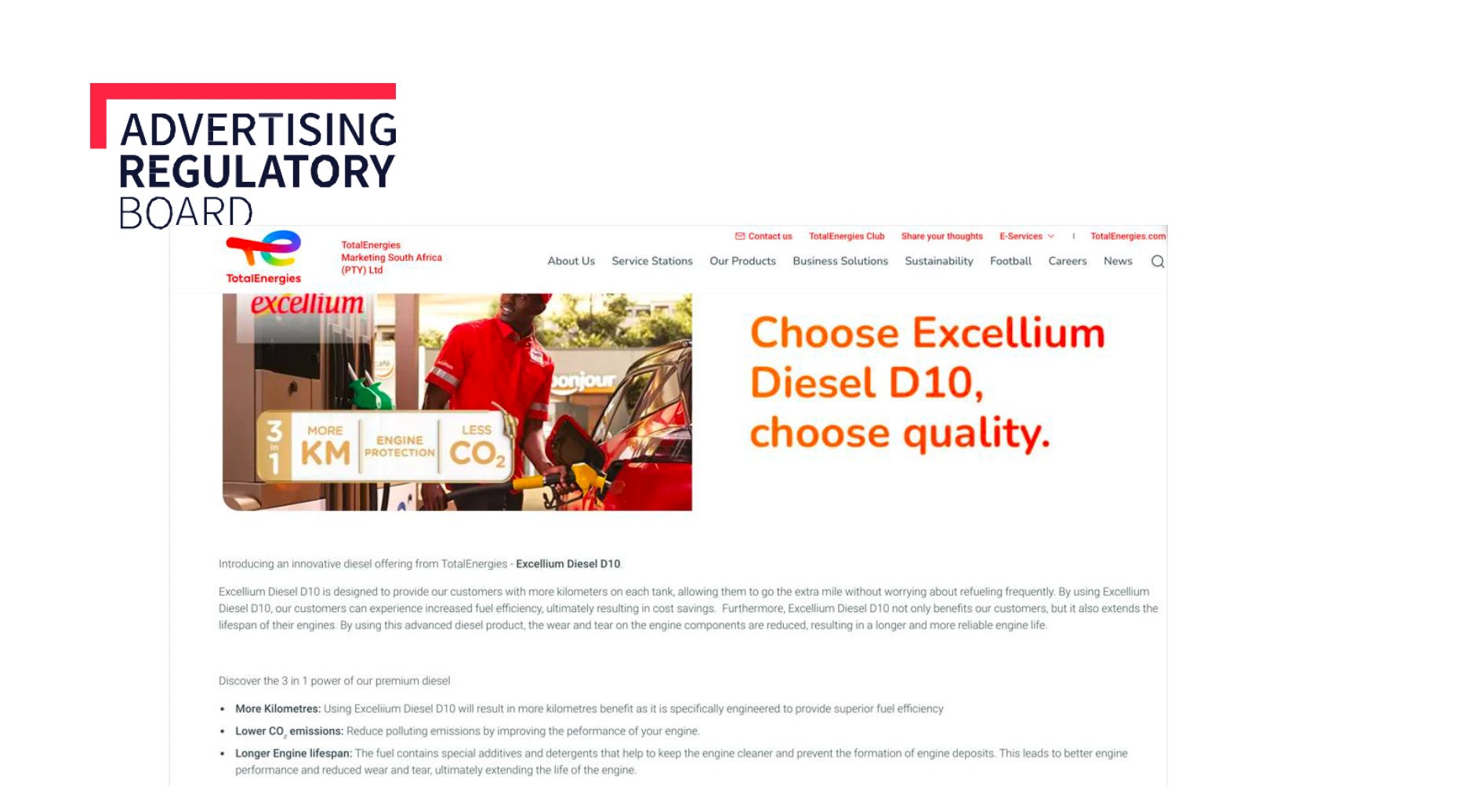
Image: screenshot of the ARB ruling
First complaint: TotalEnergies South Africa Excellium Diesel D10
The complaint against TotalEnergies South Africa’s Excellium Diesel D10 advertising was upheld by the ARB. The claim stated that the product provides “lower CO₂ emissions by improving engine performance and delivering environmental benefits.”
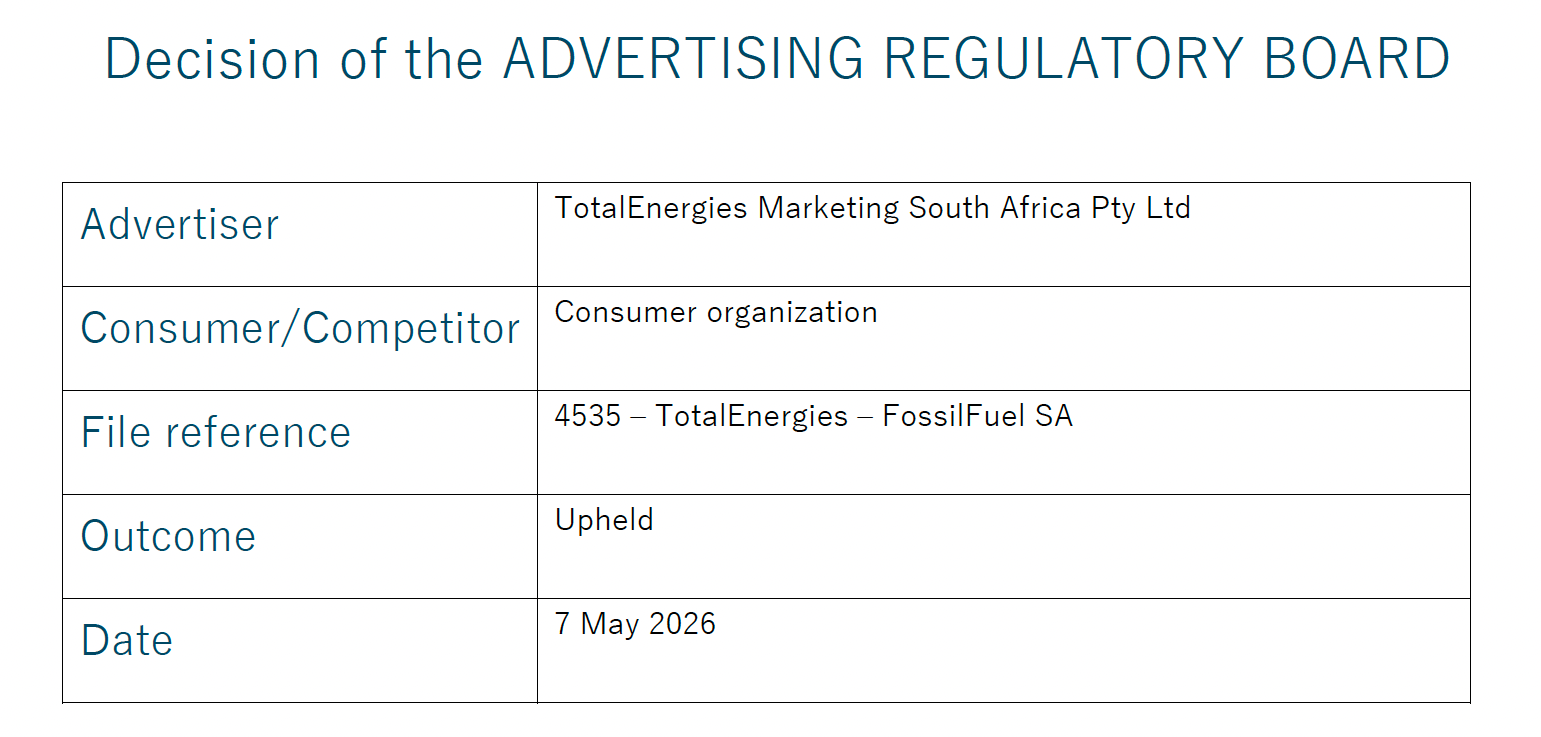
Image: screenshot of the ARB ruling
The complaint was based on concerns that the claims may mislead consumers because they lack sufficient context and supporting detail. FAB argued the advertising does not explain key assumptions such as the fuel used for comparison, the type of vehicle, driving conditions, or geographic setting, and does not clearly set out the limits of the test data used to support them.
The ARB ruled that “there is no asterisk or disclaimer indicating that the lower CO2 emissions are based on a particular test on a particular vehicle… Given this, the advertising is in breach of Clause 4.2.1 of Section II.”
Following the ARB’s decision on 7 May 2026 to uphold the complaint against TotalEnergies misleading environmental claims, the fossil fuel company has lodged an appeal against this decision.
“TMSA formally lodges an appeal against the decision, in accordance with the ARB Procedural Guide, and respectfully refers the matter to the Advertising Appeals Committee,” wrote Stephan Kotzé, Internal adjudicator for ARB, in an appeal document shared with the Fossil Ad Ban campaign.
Reflecting on this appeal, Noxolo Mfocwa, advocacy campaigner of the Fossil Ad Ban campaign, wrote in Daily Maverick that:
“A recent appeal lodged by TotalEnergies against a ruling of South Africa’s Advertising Regulatory Board (ARB) may appear, at first glance, to concern a technical dispute over a single advertising claim. In reality, it raises a much bigger question: How should regulators deal with climate misinformation in an age where deception increasingly comes dressed as accuracy?”
Second complaint: CNG Holdings
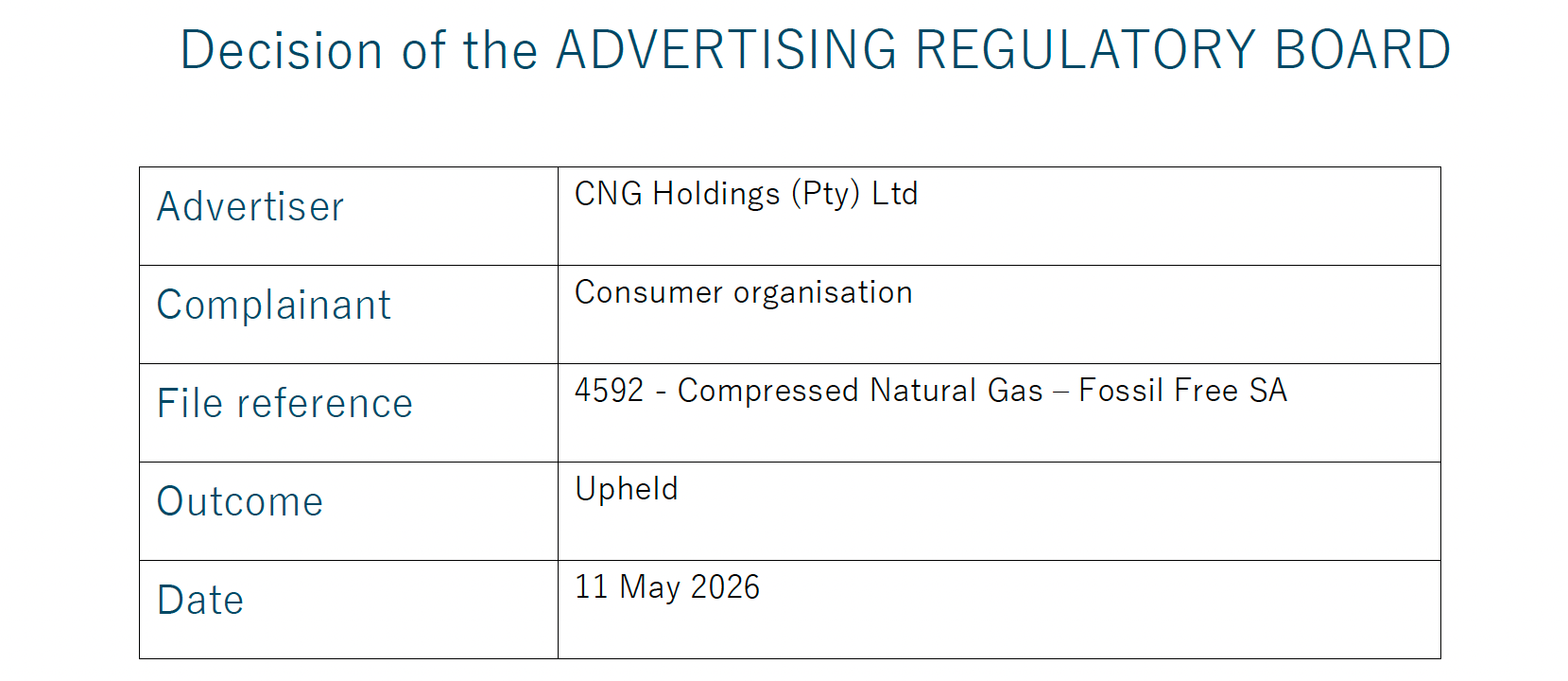
Image: screenshot of the ARB ruling
CNG Holdings made a series of environmental claims describing CNG as “clean”, “cleaner”, “greener”, “environmentally friendly”, “one of the cleanest forms of energy” and “a clean, cost‑effective energy solution”; and statements that CNG “reduces greenhouse gas emissions”, produces “virtually no particulate matter or sulphur oxides”, enables businesses to “grow sustainably” and is a “fuel of the future”.
These claims appeared on their website, as well as across promotional articles and informational pages discussing CNG’s role in transport, industrial applications, and sustainability-related initiatives.
However, our complaint argued that these statements create an overall impression of environmental benefit without adequate qualification. FAB further noted that the advertising omits key information on lifecycle greenhouse gas emissions.
The ARB ruled across three key findings:
unqualified or absolute environmental claims.
Ruling: “Accordingly, the Directorate finds that the unqualified environmental descriptors used in the advertising are likely to create an impression of overall environmental benefit and, therefore, breach Clause 4.2.1 and Appendix G.”
Substantiation for the environmental claims
Ruling: “Accordingly, the Directorate finds that the claims are unsubstantiated in breach of Clause 4.1 and Appendix G.”
Omission of material information
Ruling: “Accordingly, the Directorate finds that the advertising omits material information in a manner that contributes to a misleading overall impression, in breach of Clause 4.2.1 and Appendix G.”
Third complaint: Shell South Africa
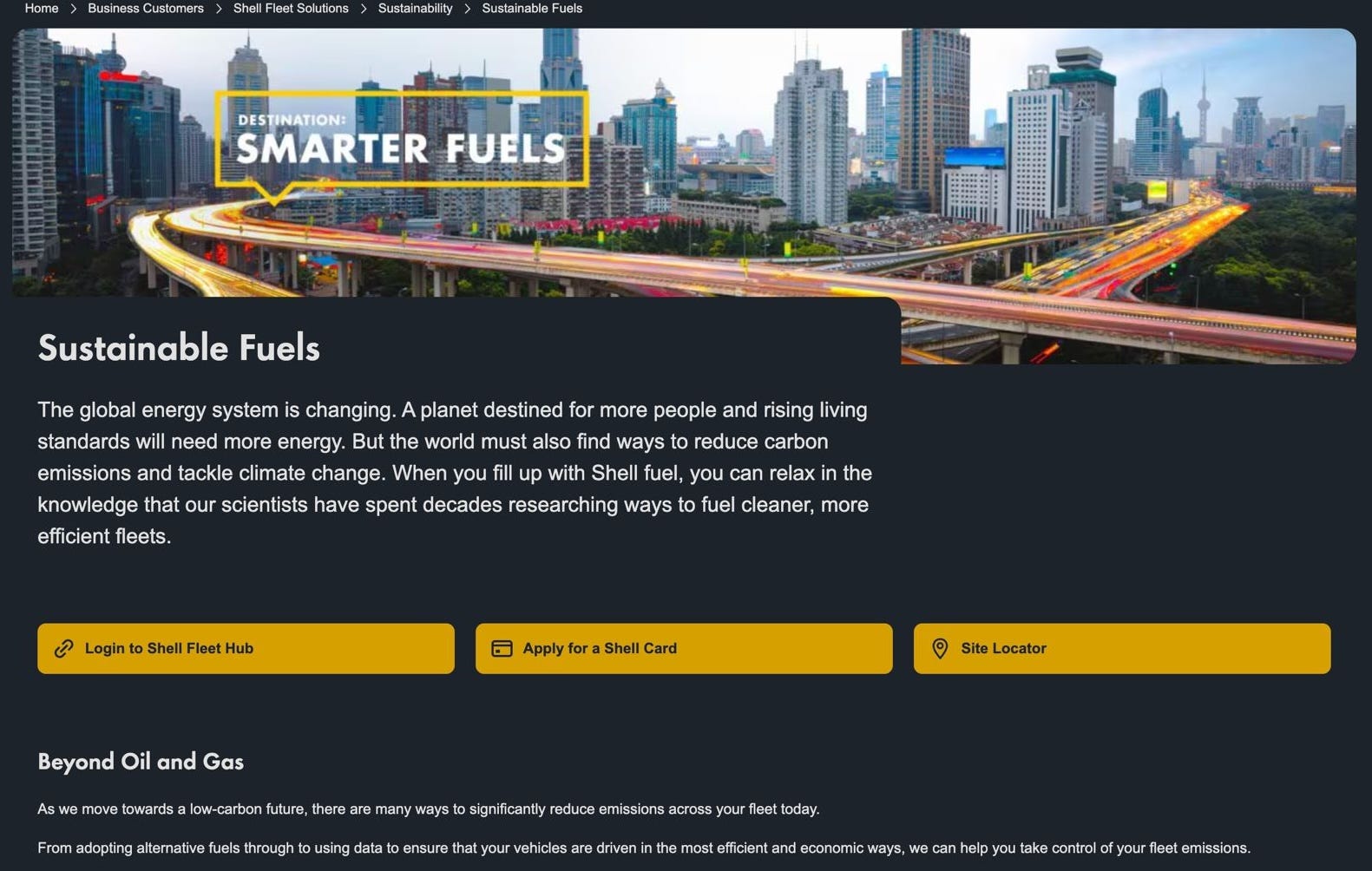
Image: screenshot of the Shell South Africa
The complaints against Shell South Africa related to webpages promoting “sustainable fuels” and “innovative fuels and lubricants”, where fossil fuel products were marketed using environmental and sustainability-linked language.
Following an investigation by the ARB, Shell provided an undertaking to remove the webpages that were the subject of the complaints and committed to withdrawing the advertising by 10 April 2026.
In line with this outcome, Clause 8.5 of the Procedural Guide allows the Directorate to accept voluntary withdrawals or amendments to advertising as an adequate resolution to a complaint. This is how the matter was resolved regarding Shell South Africa.
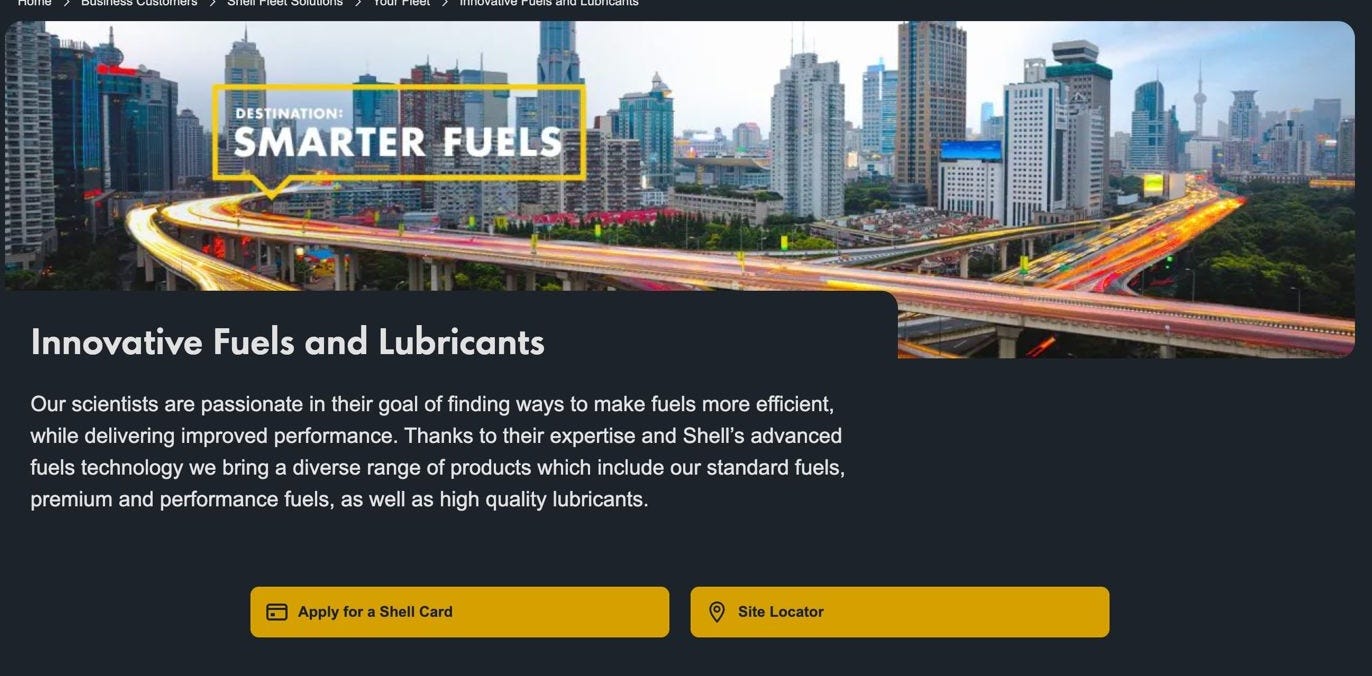
Image: screenshot of the Shell South Africa
Appendix G on environmental claims: ARB and climate accountability in three complaints
Appendix G governs environmental claims in advertising and requires that such claims be accurate, evidence-based, and grounded in scientific evidence. It defines an environmental claim as “any direct or indirect claim, representation, reference or indication in an advertisement relating to the immediate or future impact or influence on the environment of a product or its packaging or a service.”
The cases against TotalEnergies, CNG Holdings, and Shell South Africa demonstrate how environmental marketing claims in the fossil fuel sector require careful regulatory scrutiny.
Across the rulings, the ARB found that environmental and sustainability messaging lacked sufficient qualification, context, or substantiation. This is particularly important where terms like “clean,” “greener,” or “lower emissions” can create a misleading impression when used without clear scientific grounding.
For the Fossil Ad Ban campaign, these outcomes reinforce the importance of using advertising regulation as a tool for climate accountability. They show that misleading environmental claims are not only a communication issue but also a matter of public interest governance that can be challenged through formal mechanisms. These cases strengthen the argument for stricter oversight of fossil fuel advertising.
How to lodge a complaint with the ARB

Image: screenshot of the ARB website
The ARB provides a formal mechanism for challenging advertising that may be misleading, false, or not in line with the advertising code of practice. In the context of rising concerns about greenwashing, this process is an important tool for accountability.
However, access to this system may not always be equal, with language barriers and limited public awareness affecting accessibility in many communities. Strengthening public understanding of these processes is therefore essential:
Put your complaint in writing: your complaint must be clearly written
Include your name, contact details, and (for consumer complaints) your ID or passport number
Explain your complaint clearly: state the reasons for your complaint, and if possible, refer to the relevant sections of the Advertising Code
Include the advertisement: attache the advert or provide a clear copy. If not available, include details such as the advertiser’s name, link (URL), where it appeared, and when it was seen.
Provide advertiser details (if possible): include the advertiser’s contact details or the agency responsible.
Keep your complaint focused: only include information that is directly relevant and factual.
Submit your complaint: send it by email to complaint@arb.org.za or use the online form at www.arb.org.za
Make sure it is recent: The advertisement must have been published within the last 90 days.
These rulings demonstrate that environmental claims in advertising are subject to regulation and must meet the standards of accuracy, substantiation, and transparency. They also show that formal mechanisms can abe used to challenge misleading environmental messaging when it enters public spaces.
While TotalEnergies has appealed the ARB decision, the ruling itself marks an important moment for climate accountability, confirming that fossil fuel advertising is not beyond scrutiny.
At the same time, the cases highlight uneven access to regulatory processes, underscoring the need for greater public awareness and accessibility.
Ultimately, these findings strengthen the case for stronger oversight of fossil fuel advertising and reinforce the Fossil Ad Ban campaign’s call for a nationwide ban on fossil fuel advertising as part of broader efforts to address climate obstruction and ensure truthful, transparent environmental communication.